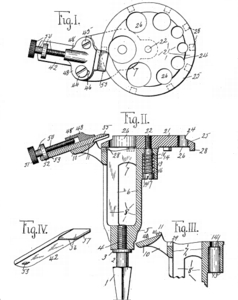
US Patent: 740,692
|
Auger
Hollow Auger
|
|
Patentee:
|
|
| William M. Potter (exact or similar names) - Syracuse, NY |
|
|
Patent Dates:
|
| Applied: |
Feb. 10, 1902 |
| Granted: |
Oct. 06, 1903 |
USPTO (New site tip)
Google Patents
Report data errors or omissions to steward
Jeff Joslin
Vintage Machinery entry for George N. Stearns & Co. | E. C. Stearns & Co.
|
|
Description: |
| From a Facebook post by James E. Price, author of the 1992 book, "A Sourcebook of United States Patents for Bitstock Tools and the Machines That Made Them"."I have three examples of the hollow auger that resulted from Potter's patent. E. C. Stearns & Co. of Syracuse, New York, manufactured it as the Stearns Adjustable Hollow Auger No. 44."The most conspicuous feature is its large revolving tenon sizing disk template. Around the disk are holes of progressively different diameters. To change the size of the tenon, the workman did not have to measure and laboriously readjust the tool. He simply lifted the disk and rotated the desired opening into working position. The Stearns catalog states that the No. 44 cut tenons in sixteenths from 3/8 inch through 1 inch. The knife could be moved forward or backward independently by means of the knurled-head adjusting screw."An Iron Age notice dated May 15, 1902 is particularly useful. It illustrates the Stearns No. 44 and explains that all adjustments could be made instantly and without tools. This advertisement appeared more than a year before Potter's patent was granted. That is readily explained by the fact that Potter had filed his patent application in February 1901. Stearns was therefore marketing the tool while the application was still pending."Potter, however, did not originate the idea of a revolving disk containing a series of holes for producing different-sized tenons. The ancestry of his tool reaches back more than thirty years."An important predecessor was Charles S. Bonney's Patent No. 105,896 of August 2, 1870. Bonney employed a revolving, scalloped template wheel having a series of different-sized openings. His patent was subsequently reissued as Reissue Patent No. 7,689 on May 22, 1877. A Shannon catalog of 1873 advertised 'Bonney's Patent Hollow Augers,' cutting from 3/8 to 1 inch in eight sizes. Surviving examples demonstrate that this was a manufactured tool and not merely an unrealized patent. If you doubt me, check all the eBay hollow auger listings."E. C. Stearns subsequently developed hollow augers based upon the same general principle. Stearns continued producing one descendant of the Bonney type for many years. A 1924 E. C. Stearns catalog, for example, illustrates the Stearns Adjustable Hollow Auger No. 4, with its conspicuous revolving perforated sizing disk. The family resemblance to Bonney's earlier tool is readily apparent."There is another patent involved in the development of my Potter/Stearns examples. Their cutter mechanisms are stamped:PAT'D / JUNE 5 / 1900"At first this presented a puzzle because Potter received no patent on that date."The answer is U.S. Patent No. 650,827, granted June 5, 1900, to James William Davis and Solon McGaw of Fayetteville, Tennessee. Their application had been filed March 6, 1900. DATAMP describes the invention as a 'Tenon Cutter' and identifies E. C. Stearns & Co. of Syracuse as the manufacturer, although no assignee was recorded on the patent."The Davis and McGaw patent concerns the cutter mechanism rather than originating the revolving multiple-size template principle. Its patent drawing shows the adjustable cutter arrangement and associated screws. Thus the June 5, 1900 date stamped on the Stearns tools refers to the Davis and McGaw invention, not to Potter."This makes the No. 44 particularly interesting because it is not simply the product of one inventor. It represents the accumulation and refinement of ideas extending over several decades."The developmental sequence can be summarized generally as:Bonney Patent No. 105,896 - 1870 --> subsequent Stearns developments --> Davis & McGaw Patent No. 650,827 --> 1900 --> Potter Patent No. 740,692 — 1903."By Potter's time the hollow auger itself was hardly a new tool. American inventors had been patenting improvements to hollow augers throughout much of the nineteenth century. What Potter and Stearns produced was a highly developed version in which selecting a tenon diameter was remarkably convenient. The workman could rotate the disk to the required size and make the necessary knife adjustment without resorting to separate adjusting tools."My three examples also illustrate differences in finish and details that probably resulted from production over a period of time. One retains conspicuous traces of red paint on the cutter mechanism, while the others have somewhat different surviving finishes and hardware. All three nevertheless retain the characteristic perforated sizing disk and the general construction of the Stearns No. 44."I find this tool particularly interesting because it illustrates why a patented tool should not always be studied by looking at a single patent. Potter's 1903 patent is only the last chapter in this story. The actual manufactured tool preserves ideas contributed by earlier inventors and refined by E. C. Stearns & Co. over decades."In that sense, the Stearns No. 44 is almost a mechanical genealogy of the American hollow auger—an old wheelwright's and chairmaker's tool brought to a remarkably sophisticated state of development near the end of its working life. By 1930 hollow augers had essentially become obsolete." |
|