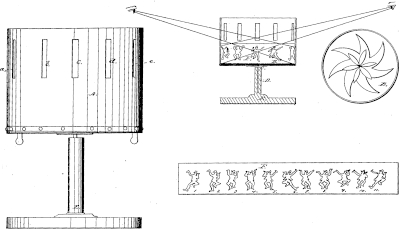
US Patent: 64,117
|
Toy
Zoetrope
|
|
Patentee:
|
|
| William E. Lincoln (exact or similar names) - Providence, RI |
|
|
Patent Dates:
|
| Granted: |
Apr. 23, 1867 |
USPTO (New site tip)
Google Patents
Report data errors or omissions to steward
Jeff Joslin
|
|
Description: |
| In 1834, British mathematician William George Horner invented a device for creating animation using a series of still images: the images are wrapped around the inside of a drum with slits in between the figures. By peering through the slits, one image at a time is revealed in such a way that the viewer perceives not a series of still images, but a single image that moves. In 1867 William E. Lincoln, an 18 year old student at Brown University in Providence, RI, improved on Horner's invention by moving the slits above the images, which made it easier to use replaceable image strips. The patent calls the device a "zoëtrope", a word Lincoln created by combining the Greek works for "life" and "turn". This toy was manufactured by Milton Bradley & Co. It was quite successful and engendered numerous variations on the idea. Nowadays zoetropes are remembered as an important stepping stone toward the development of motion pictures. |
|