US Patent: 32,149
|
| Air and Steam Engine
|
|
Patentees:
|
| R. E. Rogers (exact or similar names) - Philadelphia, PA |
| James Black (exact or similar names) - Philadelphia, PA |
| Manufacturer: |
| Not known to have been produced |
|
|
Patent Dates:
|
| Granted: |
Apr. 23, 1861 |
|
Patent Pictures:
[
1 | 2
]
|
|
|
USPTO (New site tip)
Google Patents
Report data errors or omissions to steward
Joel Havens
|
|
Description: |
| Abstract:
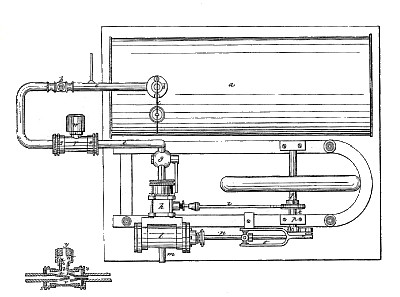
Atmospheric air and steam, and air and water heated either by the air or otherwise to the vaporizing point, and air and the gaseous products of combustion and steam have been mingled or associated, and used as a motive power. Desirable as is the result of turning to profitable account the expansive and elastic power of so cheap and safe a material as air, yet none of the devices for employing it, either alone or in conjunction with steam, have hitherto been productive of any large amount of effective power, when compared to the dimensions of the engine used. In all instances when these elements have been used, the air, or other gaseous material, has been fed into the steam or water by means of a force-pump or air- pump driven by the power of the engine. So much, therefore, of the power of the engine as is consumed in forcing in the air, is necessarily lost; and this is the serious objection and chief drawback to the employment, in the ordinary way, of air in connection with steam. By our invention, which is self-acting in its operation, the air ]s introduced and commingled with the steam, through the agency and by the power of the current of the steam itself on its way from the generator to the motive cylinder of the engine. Our invention is based upon the principle that a current of steam, air, or other fluid hotly issuing from an orifice will carry along with it any other fluid body surrounding it.
Claim:
What we consider as new and original is the method of using air and steam as a motive power; and we may state that we have clearly ascertained that by this method of intimately combining or blending the air and steam, the "latent caloric " of the steam, to say nothing of its "sensible caloric " is rendered remarkable available in expanding the air, whose "specific heat" or "capacity for caloric" is known to be low. |
|




)
)