US Patent: 1,464,062
|
| Automatic Multiple-Spindle Metal-Working Machine
|
|
Patentee:
|
|
| Lee G. Daniels (exact or similar names) - Rockford, Winnebago County, IL |
|
|
Patent Dates:
|
| Applied: |
Sep. 27, 1920 |
| Granted: |
Aug. 07, 1923 |
|
Patent Pictures:
[
1 | 2 | 3 | 4 | 5 | 6
]
|
|
|
USPTO (New site tip)
Google Patents
Report data errors or omissions to steward
Joel Havens
|
|
Description: |
| This patent was listed on a Bullard Maxi-Mill patent plate.
Abstract:
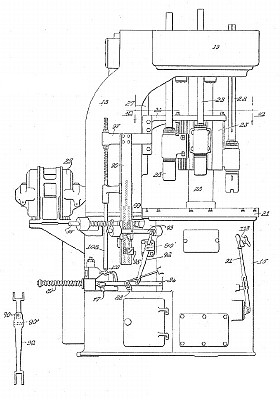
This invention pertains, to automatic 1n metal working machines, and has more particular reference to the general type disclosed in my Patent No. 1274859, dated August 6, 1918. Such class of machines is characterized by the inclusion of a plurality of tool carriers and work carriers, which are relatively indexed in step by step movements to bring the work successively into operative relation with the various tools and at each station a relative movement between the tools and work is effected, preferably by feed of the tools, to simultaneously perform a plurality of operations. Such machines are further characterized by the provision of mechanism which automatically regulates and controls the various, movements in a predetermined manner, The primary object of the present invention is to provide an automatic multiple spindle metal working machine of the character described, of novel construction, designed to obtain a most efficient means for machining parts in large quantities, with the use of semiskilled labor to operate the machine after it is set up and timed for the various operations, thus offsetting increasing labor costs and effectually meeting the need for increased production.
Claim:
In a multiple spindle machine of the character described having a work carrier and a multiple spindle tool carrier, mechanism for relatively moving said carriers in rapid approach, feed and reverse movements, mechanism for indexing one of the carriers, control mechanism for automatically causing the first mentioned mechanism to produce said rapid approach, feed and reverse movements in predetermined relation, and means operable at the will of an operator for causing the first mentioned mechanism, during control thereof by said control mechanism, to function different from the predetermined automatic operator. |
|




)
)
)
)
)
)