US Patent: 3,248,101
|
| Dual Swivel Axes Clamping Table
|
|
Patentees:
|
| Johann Müller (exact or similar names) - Munich, Munich District, Bavaria, Germany |
| Horst Lanzenberger (exact or similar names) - Munich, Munich District, Bavaria, Germany |
|
|
Patent Dates:
|
| Applied: |
Feb. 14, 1963 |
| Granted: |
Apr. 26, 1966 |
|
Patent Pictures:
[
1 | 2 | 3
]
|
|
|
USPTO (New site tip)
Google Patents
Report data errors or omissions to steward
Joel Havens
"Vintage Machinery" entry for Friedrich Deckel GmbH
|
|
Description: |
| This patent was improved by patent #3,361,033.
Claims priority, application in Germany, Feb. 20, 1962.
Abstract:
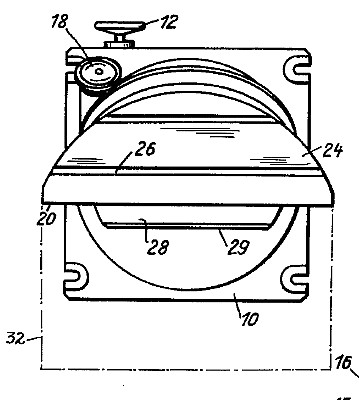
This invention relates broadly to clamping tables, and more particularly to a clamping table for machine tools in which the clamping surface can be swiveled around a first axis inclined at 450 to the plane of the clamping sur- face, and also around a second axis inclined at 45° to the first axis. Clamping tables of this same general type, that is, the type having a clamping surface which can be swiveled about two separate axes disposed at 45° to each other, are familiar to those skilled in the art, but with the dual swivel clamping tables, known in the prior art, the workpiece clamped on the clamping surface must be raised or lowered a substantial distance on the swinging of the clamping surface about the first axis which is inclined at 45° to the horizontal plane. This is particularly disadvantageous in the processing of large workpieces because an especially strong power source is required to drive the table to swing the workpiece with a raising or lowering component to the desired position relative to the machine tool. In addition, clamping tables of the prior art of this type have still another disadvantage. Upon swiveling the workpiece and clamping surface about the first axis, that is the axis inclined at 45° to the horizontal, the workpiece changes its position in space rather drastically. For instance, if a workpiece is centrally clamped on the clamping surface, upon swinging the clamping surface from the vertical plane into the horizontal plane the workpiece in addition to being raised at least half the width of the clamping surface is also displaced backwards by an approximately equally great amount. If the prior art device is used as a clamping table for a machine tool, then the machine tool requires particularly long infeed adjustment possibilities, in order to compensate for the rather drastic displacement of the workpiece relative to the tool after swinging the workpiece from one position to another.
Claim:
A pivotable clamping table of the type used with machine tools including, a pedestal portion, a bearing surface on said pedestal portion, a body portion, a clamping surface for a workpiece connected on said body portion, said clamping surface having inner and outer edge portions with said inner edge portion disposed adjacent said bearing surface, and said body portion pivotally connected to said bearing surface along a swivel axis inclined at an angle of substantially 45° to the plane of said clamping surface and intersecting said clamping surface adjacent the inner edge portion. |
|




)
)
)