US Patent: 541,620
|
| Injector
|
|
Patentee:
|
|
| Strickland L. Kneass (exact or similar names) - Philadelphia, PA |
|
|
Patent Dates:
|
| Applied: |
Apr. 20, 1895 |
| Granted: |
Jun. 25, 1895 |
|
Patent Pictures:
[
1 | 2 | 3
]
|
|
|
USPTO (New site tip)
Google Patents
Report data errors or omissions to steward
Joel Havens
"Vintage Machinery" entry for William Sellers & Co.
|
|
Description: |
| Abstract:
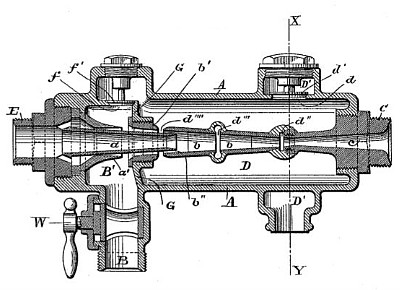
My invention relates to that form of injector in which the receiving end of the combining tube, and one or more of its additional openings, are contained in one chamber, and the description which follows will apply especially to that type in which two jets of steam or other actuating fluid are placed in the same axial line, so that the velocity of the water or other liquid may be constantly accelerated until it has acquired sufficient velocity to enter the boiler. All injectors in which the nozzles are fixed o and the areas of steam discharge and of water entrance to the combining tube are constant, have a steam pressure which is hereinafter called the limiting steam pressure, at which the maximum quantity of water will be delivered to the boiler, and above which, n- der the same conditions of water supply pressure and temperature, the capacity will decrease as the steam pressure is raised. During the operation of an injector, the absolute o pressure within the upper part of the combining tube where the steam jet comes in contact with the cold water supply, is always lower than the pressure in the supply chamber, owing to the partial vacuum caused by the condensation of the steam, and it is this difference in pressure which causes the snpply water to flow into the receiving end of the combining tube. As the area of this opening into the combining tube is constant, and the o difference in pressure is at its maxim um when the limiting steam pressure is reached, any increase in the weight of steam discharged, due to a rise in the steam pressure, will not be met by a corresponding increase of the inflow of the supply water to the combining tube, but, on the contrary, the less complete condensation of the steam in the upper part of this tube will reduce the difference in pressure and the inflow of feed will be lessened. Whenever an insufficient supply of water is provided, immediate condensation of the steam is not effected within the combining tube, and the low internal pressure will be communicated to and maintained in the surrounding overflow chamber, if provided with a suitable valve against the admission of air. The limiting steam pressure in the form of injector to which my invention chiefly ap- plies, and which is shown and described in United States Patent No. 376,315, granted to me January 10, 1887, is higher than that of other forms of injectors having fixed areas of admission, because its action depends upon certain relations which are nonexistent in other types. In the form of injector to which reference is made, the two actuating jets are placed in the same axial line and the combining tube of the lifting set discharges directly into the receiving end of the forcing combining tube. The capacity of this injector is much greater than that of its lifting set alone, owing to the fact that when the two sets are working in conjunction, the pressure within the receiving end of the forcing combining tube is reduced considerably below that of the atmosphere by the condensation of the forcing steam jet. These conditions obtain as the steam pressure rises, until the increased discharge from the forcing steam nozzle requires a greater supply of water than the lifting set can force through the fixed area of admission of the receiving end of the forcing combining tube, when the jet in this tube, while passing the apertures which open into the overflow chamber, will produce a partial vacuum at those points, and consequently also in the overflow chamber. Some of the water from the lifting set will then be diverted by this partial vacuum from the receiving end of the forcing combining tube into the overflow chamber, through the opening between the combining tubes of the lifting and the forcing sets, and will submerge the apertures in this forcing tube. The jet in this tube will 95 then draw this water in the overflow chamber into the combining tube through its submerged apertures and carry it into the delivery tube, thus materially increasing the capacity of the injector. These conditions obtain as the steam pressure rises, until the larger area of the lifting combining tube is just sufficient to supply the additional amount of water necessary for the condensation of the increased steam discharge, when the limiting steam pressure of this form of injector is reached, because the jet in the forcing combining tube requires for any increase in the steam pressure, an additional supply of water, which heretofore could not be provided without interfering with the satisfactory performance of the lifting nozzles at the lower pressures it is frequently desirable to use.
Claim:
An injector in which the actuating steam is divided into two or more jets and includes an overflow chamber which contains the receiving end and one or more apertures of a forcing combining tube, an outlet port to the r; air, and a supplemental inlet port from the water supply. |
|




)
)
)