US Patent: 659,944
|
| Gas Engine
|
|
Patentee:
|
|
| Harry D. Weed (exact or similar names) - Syracuse, Onondaga County, NY |
| Manufacturer: |
| Not known to have been produced |
|
|
Patent Dates:
|
| Applied: |
Mar. 24, 1900 |
| Granted: |
Oct. 16, 1900 |
|
Patent Pictures:
[
1 | 2
]
|
|
|
USPTO (New site tip)
Google Patents
Report data errors or omissions to steward
Joel Havens
|
|
Description: |
| Abstract:
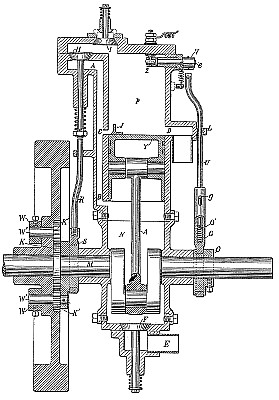
The invention subject of my present application is an improvement in gas-engines, more particularly of the class known es two-cycle explosive-engines, and has for its main objects to simplify end improve the construction of such engines, to increase their efficiency, and to provide for better regulation of the same, especially with a view to rendering them more available in small sizes for use in the propulsion of vehicles und other analogous purposes.
The specific features of the invention are largely matters of constructive detail; but e prominent feature to which I attribute much of the practical success of the engine consists in a means for regulating the force of the explosion in proportion to the amount of Work which the engine is called upon to perform and which, stated in general terms, is es follows: In conjunction with the working cylinder and a gas-chamber and a piston common to both, I employ means for introducing into the working cylinder from the gas-chamber a full charge of mixed gas and air at or near the end of forward movement of each stroke, which displaces the gaseous products of combustion within the cylinder and is then, prior to ignition, compressed by the return of the piston. Under conditions of full load, when the maximum expensive effect of each explosion is required, the whole charge of mixed air and gas is retained and exploded within the cylinder; but should the load be lessened, the maximum explosive effect would be in. excess of the requirements of the work to be done. To compensate for this, I provide means, preferably automatic, by which a portion of the unexploded charge corresponding in amount to the decrease in load is withdrawn from the working cylinder und returned through a suitable bypass to the opposite side of the same, so that the actual charge, which remains to be exploded is proportioned in amount to the work, which the engine is called on to perform.
Claim:
In a gas engine the combination with a working cylinder, a gas-chamber communicating with said cylinder and a piston common to both said cylinder and said chamber, of means for admitting to the working cylinder full charges of explosive gas from the gas-chamber and means whereby a portion of the admitted charge of gas proportionate to the amount of work the engine is called upon to perform is withdrawn from the working cylinder prior to ignition. |
|




)
)