US Patent: 141,173
|
| Self-Adjusting Injectors for Feeding Boilers
|
|
Patentee:
|
|
| William Sellers (exact or similar names) - Philadelphia, PA |
|
|
Patent Dates:
|
| Applied: |
Jun. 13, 1873 |
| Granted: |
Jul. 22, 1873 |
USPTO (New site tip)
Google Patents
Report data errors or omissions to steward
Joel Havens
"Vintage Machinery" entry for William Sellers & Co.
|
|
Description: |
| Abstract:
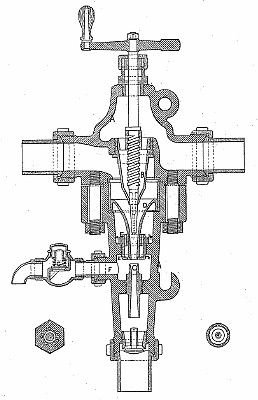
The construction of the Giffard injector has been from time to time improved from the date of its introduction into public use by its inventor. It has always been provided with three separate nozzles or tubes, designated in the technology of the instrument as the receiving, the combining, and the delivery tubes, the combining-tube always being interposed between the other two; and in some of the earliest improved constructions provision was made for a limited adjustment between all of these nozzles. The self-adjusting injector was first described in the patent No. 49,445, issued to me August 15, 1865. This instrument was subsequently improved by me, as described in the patent No. 75,059, granted to me March 3, 1868, and the present invention is an improvement upon this latter construction. In the self-adjusting injectors constructed by me previous to this present invention, the combining and delivery tubes were attached to each other, and the regulation of the water was effected by moving these tubes toward and from the steam-discharging nozzle, or, as it is technically termed, the receiving-tube. In the instrument as first constructed by me the combining and delivery tubes moved through stuffing-boxes of equal diameter, the boiler-pressure being exerted between them, so that this pressure could have no influence tending to move these tubes in the direction of their axis. In the instrument patented by me in 1868, the exterior diameter of the delivery-tube was made as small as possible, and the boiler-pressure was exerted upon so much of the end of this tube as was exposed to it outside of the jet; this amount was so small as to exert no appreciable influence upon the self-regulating quality of the instrument, while its delicacy of adjustment was materially increased by dispensing entirely with the stuffing-boxes used in the first instrument. This latter was rendered possible by the small amount of boiler-pressure, which avoided all necessity for balancing it, so that one stuffing- box was dispensed with on this account and the reflux of water to the overflow-chamber was guarded against by pressing the delivery- tube through a long bushing, which served as a water packing, in place of the other stuffing- box, thus creating much less friction than the stuffing-box first used. It has been found, however, in practice that with gritty water this bushing is liable to wear under the constant movement of the delivery-tube, as it adjusts itself to the variations in the pressure of steam, and in time this wear becomes sufficient to allow enough water to pass into the overflow-chamber to prevent the operation of the instrument. In all the self-adjusting injectors constructed by me the adjustment has been effected by exposing the fluid jet between the combining and delivery tubes to the contents of the closed overflow-chamber, through which the jet passes on its way to the boiler and in all these instruments, previous to this invention, the distance between these tubes has been fixed by their construction. I have now discovered that the distance between these tubes may be greatly varied, and that the length of the jet exposed to the contents of the overflow-chamber may be correspondingly varied without impairing its efficiency to enter the boiler or to regulate the water-sup- ply; and I believe this capacity of the jet was never before known until I discovered it. This discovery enables me to separate the combining and delivery tubes as they were in the original Giffard injector, to fig the delivery- tube in the casing, and to effect the regulation of the water by the movement of the combining-tube alone, by this arrangement obviating entirely the wear previously described between the movable delivery-tube and its bushing; and this constitutes the first part of my present invention. In all self-adjusting injectors previous to my present invention, the waste of water required to start the instrument as a boiler- feeder has been provided for by an orifice between the delivery-tube and the boiler. In the patent No. 75,059 means were described for making this waste automatic, and the es- cape-valve, in that instance, was always exposed to the boiler-pressure when closed. Any deposit upon the valve-face would cause a serious waste of water under such a pressure, and consequently its use was only satisfactory when the instrument was supplied with pure water. I have now discovered that, by passing the jet through an orifice of suitable size, in a diaphragm between the combining and delivery tubes, the waste at starting may take place in the overflow-chamber itself through a moderately-weighted check-valve, which will close automatically when the jet has acquired sufficient velocity to enter the boiler; and this constitutes the second part of my invention.
Claim:
The combination, with a fixed receiving-tube and a fixed delivery-tube of a self-adjusting combining-tube |
|